Saturday, 10 October 2020

The Virtual London Marathon


Life begins at 40

A highlight of life in the U.K this and every year since 1981 is the London Marathon.  

London Marathon (source: VirginMoney)

It was Chris Brasher, winner of the Olympic steeplechase title in 1956 who established the event.  In so doing he is credited with changing people’s lives.   World Athletics, the IAFF, stated[i] on his passing in 2003 that the event

“.. triggered the fitness culture in Britain and altered the way we look after our bodies, it has inspired the raising of millions of pounds for charities and, above all, simply helps to make the British capital a better more smiling place on at least one day each year.”

To this day it continues to provide a beautiful advertisement for London – inviting, efficient, and friendly.  The spectacle of the world’s best long distance athletes combined with everyday people competing to raise money for good causes is irresistible.

With spectating at the event this year being ruled out for the first time, the alternative way to become part of the occasion is to enjoy the thrilling coverage provided by the national broadcaster.[ii]   There are many reasons to watch it, especially to witness the poignant and humbling narratives of fund-raising athletes.[iii]

And this year, more than ever, their stories make the event a perfect metaphor as the human spirit’s capacity for triumph over adversity.

A cherished event marking the special occasion of its 40th anniversary cannot easily be overlooked. Unthinkably, however, it almost didn’t happen.  Cancelled on its usual slot in mid-April, this centrepiece of the athletics calendar is a rare example of a rearranged fixture.  That happened on Sunday 4 October 2020.  

Chris Brasher’s legacy thrives.

Charities in Crisis

A telling consequence of the pandemic has been that charities have been struggling for survival. 

A report in August by the Institute of Fundraising which surveyed over 500 charities confirmed a picture of consistent bleakness.   It findings told a story of charities’ revenues falling so much as to imperil their work and very existence.[iv]   

Age UK, for example, reported that demand for its services had “gone through the roof” despite having to furlough 75% of its staff.  More recently, Metro reported[v] that “despite an increased demand for their services, charities have seen a drop in donations mainly due to the cancellation of fundraising events.” 

London adapts

Evidence for the importance of the London Marathon to charities was articulated this month by the race organisers. The 2019 event alone raised over £66 million in charitable donations. That brought the total given since the first race in 1981 to “more than £1 billion.”

To cater for the new abnormal and ensure compliance with public health requirements the 2020 event took place as two editions staged simultaneously.  The élite athletes ran 20 laps around St James’s Park, starting on the Mall in the heart of London; the masses took part everywhere else, both at home and abroad in “virtual” form.

The Collins family

Among the 45,000 participants was my son in law Bob and his wife (my daughter Lynda). Their motivation was to say thanks to the medical organisation which is treating Bob for life-changing injuries received in June 2018 when a car knocked him and a colleague off their bikes. 

Following the diagnosis of permanent brain damage affecting memory and concentration (among other injuries), Bob has been a patient at Graham Anderson House in Glasgow arranged under the auspices of BIRT.  The acronym stands for the Brain Injury Rehabilitation Trust.[vi]

Paisley Daily Express 3 Oct 2020


Such were his injuries that he had to learn to walk again.  He has also had to endure the upheaval of prematurely retiring from work in BAE Systems as a naval architect designing war ships.  In addition, he has had to quit his extracurricular role as youth coach at Paisley Rugby Club. 


Bob's course included a stop at Paisley RFC
 

Given the freedom to choose a 26.2 mile route, most people would plot a course that is flat and downhill.  (That’s what lazy me would do). 

Graphic of route and net time taken. Source:- Bob's Strava feed
 

Instead Bob’s marathon involved 1,500 feet of ascending, off-road muddy paths, all within a deliberate strategy to include nature and to avoid noise.  Because the latter can adversely affect his concentration, tranquil surroundings matter. 

Bob and Lynda were delighted when on the eve of the event their teenage son Ben decided to join them for the entire course.  Unexpected but welcome additional support also came from friends and family either walking part of the route with them, bringing coffee, or from neighbours who gathered at the finish to welcome the family back home.  


The father of girl player coached by Bob in Paisley RFC cycled out to walk with team Collins


Family from East Kilbride meet Collins trio at LochWinnoch
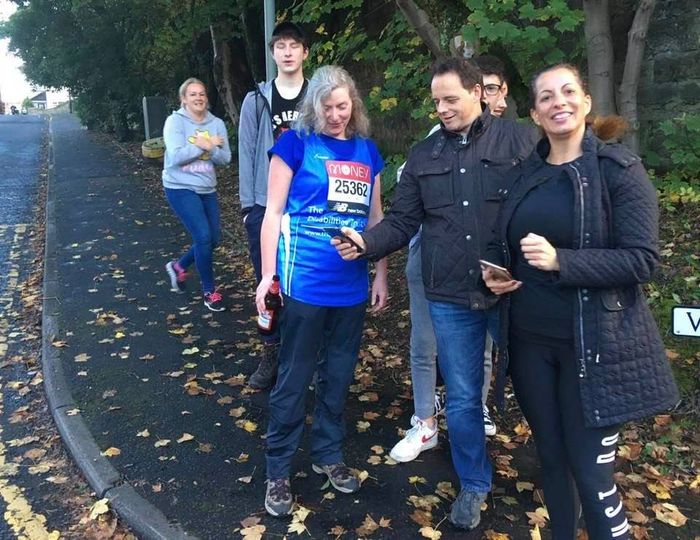

Friends (including cycling colleague Chris Terris and wife Connie) welcome the marathoners home

Thanks to the wonders of modern technology, family and friends were able to check on progress on the London Marathon’s special app.


The sore feet and limbs were all worth the eight and a half gruelling hours of effort.  This can be measured by the success of a 2-week period of fund-raising.   In that short time, the donations raised for BIRT came to (including Gift Aid) £4,200.[vii] (The donations page remains open).

Scotland’s corona virus restrictions ruled out any spontaneous post-event celebratory house party. That can wait for another day.


Achievement

As an able-bodied participant in the London Marathon on six occasions between 1985 and 1993 (no whippersnapper but still younger then than Bob and Lynda now) - when thousands of Londoners lined the streets yelling support which makes quitting impossible - I admire what my son-in-law’s family has achieved in difficult circumstances.  

They had to cope with Covid-19.  They have joined Chris Brasher’s  “triumph of the human spirit over adversity” club on London Marathon's milestone anniversary.  Above all, Bob (en famille) has won a heroic battle on a difficult course as he continues to recuperate from injury.

As they await receipt of their medals and tee-shirts, Bob Lynda and Ben were immensely encouraged by the support of their sponsors.  The same applies to the publicity in last Saturday’s and also today’s local paper[viii] with its emphatic full centre-page spread. 

Paisley Daily Express 10 Oct 2020


©Michael McSorley 2020


Postscript:-

This Covid-19 series comprises of 10 articles to date:- 

Part 1 (24 March 2020) A Test for Elected Leaders[ix] 

Part 2 (11 April 2020) Coping with Contagion, a Survival Strategy.[x]

Part 3 (30 April 2020) The New Vocabulary[xi]

Part 4 (21 May 2020) Following the Science[xii]

Part 5 (11 June 2020) Beautiful books[xiii]

Part 6 (25 June 2020) Stone Circles[xiv]

Part 7 (26 July 2020) Finding positives in a global crisis[xv]

Part 8 (21 August 2020) Humour for the pandemic[xvi]

Part 9 (28 September 2020) Holidays at Home[xvii]

Part 10 (10 October 2020) The London Marathon


BIBLIOGRAPHY


[i] IAFF 28 Feb 2003 “Chris Brasher Olympic Champion and Co-founder of the London Marathon dies” https://worldathletics.org/news/news/chris-brasher-olympic-champion-and-co-founder?fbclid=IwAR2cUsVY1YaTX-GhGCNUSQ3WyG7TLq4mSTxk_4Gg2g6M5GIAvyo_mUWgfiE

[ii] https://www.bbc.co.uk/iplayer/episode/m000n7cd/london-marathon-2020-highlights

[iii] https://michaelmcsorleyculture.blogspot.com/2014/04/fifteen-reasons-to-watch-london.html

[iv] https://www.institute-of-fundraising.org.uk/guidance/coronavirus/round-up-coronavirus-impact-on-charities/

[v]Metro.co.uk 15 September 2020 Sian Elvin. ”The Impact of the pandemic on small charities”  https://metro.co.uk/2020/09/15/were-needed-more-than-ever-the-impact-of-the-pandemic-on-small-charities-13269758/

[vi] Paisley Daily Express 3 October 2020 page 3 David Campbell 

https://www.dailyrecord.co.uk/news/local-news/bob-takes-london-marathon-challenge-22783544

[viii] Paisley Daily Express 10 October 2020

[ix] https://michaelcovid19.blogspot.com/2020/03/a-test-for-elected-leaders.html

[x] https://michaelcovid19.blogspot.com/2020/04/coping-with-contagion-survival-strategy.html

[xi] https://michaelcovid19.blogspot.com/2020/04/the-new-vocabulary.html

[xii] https://michaelcovid19.blogspot.com/2020/05/following-science.html

[xiii] https://michaelcovid19.blogspot.com/2020/06/beautiful-books.html

[xiv] https://michaelcovid19.blogspot.com/2020/06/the-archaeology-of-stone-circles.html

[xv] https://michaelcovid19.blogspot.com/2020/07/finding-positives-in-global-crisis.html

[xvi] https://michaelcovid19.blogspot.com/2020/08/humour-for-pandemic.html

[xvii] https://michaelcovid19.blogspot.com/2020/09/holidays-at-home.html

Monday, 28 September 2020

Holidays at home

 Introduction

Just before the autumn equinox, this retired couple enjoyed two exhilarating short holiday breaks at home - “within the jurisdiction.”  Mid September obliged by providing warmer days than did August.   

We needed no excuse to escape, but the return of sunshine beckoned us to rediscover some neglected charms on our doorstep. An added benefit was travel without the hassle of invasive airport security.

With trips abroad frowned upon by Government and foreign travel deemed as “non-essential” the official line is to holiday locally.  Post-lockdown, the services of hospitality and leisure relied on the regional market to provide a semblance of sustainability.  This especially after a prolonged period of closure and inactivity.  Local patriotism comes to the rescue.

Having heeded the advice to “stay at home” for nearly half a year, the loosening of restrictions motivated us to try two top notch locations in consecutive weeks.  One (87 miles door to door) was in Fermanagh where I spent a productive period of my professional work-life; the other (60 miles door to door) was in the area of Tyrone whence my wife hails .  

A common denominator is that both destinations are located in areas of considerable scenic beauty.

Fermanagh

This next paragraph might, at first, seem like a non-sequitur.  

In June 2013, the then Prime Minister David Cameron responded to protests which had accompanied previous leaders’ meetings about the global economy, by picking a location for the G8 summit well away from metropolitan Britain.  Where better than the idyllic rural west of Northern Ireland, the Lough Erne Resort outside Enniskillen.  As they were meeting in my old patch, I deemed it only right to compile a hefty agenda[i] for their attention.


Famously the PM fitted in an early morning wild water swim[ii] allegedly to counter or upstage Vladimir Putin should he have been considering a similar act of selfless heroism.  Of the other world leaders, only the German Chancellor Angela Merkel reached out by making an impromptu late night boat trip across the lake.  She visited another hotel to brief German journalists (perhaps also to escape from the madness).

G8 Summit Enniskillen June 2013 "the family photograph"

For outsiders unfamiliar with the geography of civilisation, let me set the scene[iii]:-

·         Fermanagh attracts visitors primarily because of its outstanding natural environment including an extensive lakeland replete with 170 islands; and

·         compared to similar areas like the Norfolk Broads in England, the Irish waterway is quieter with lower density of boating traffic.

And two lesser known facts:-

·         I recall from my work days that even in the dark era of the “Troubles” Fermanagh retained its ability to attract European visitors back for return visits to take part in fishing competitions; and

·         my former trusted work colleague’s caustic description of his native county was that for half of the year Lough Erne is in Fermanagh and for the other half Fermanagh is in Lough Erne.  This, to me, explains why the Romans named Ireland after the Latin word for winter, Hibernia.

Because this was our first holiday since a trip last December to Cape Verde, residential choice was influenced by the continuing imperative for social distancing.   As the Fermanagh hotel includes detached lodges, we used that excuse to trade up and improve distancing.  As a result, we found ourselves in a commodious lakeside property (five rooms over two floors) complete with panoramic views.[iv]  


Although the place’s raison d’être is a championship golf course, designed by Major-winning English golfer Nick Faldo, we were content to observe the largely male contingents of golfing enthusiasts helpfully supporting our beleaguered economy.

One of Northern Ireland’s biggest visitor attractions has become the walk up Cuilcagh Mountain[v] near Marble Arch caves.  Since the addition of a boardwalk and steps to protect the upland bog and to ease access, this out and back 7-mile route has grown hugely in popularity.  So much so that, during some of the sunniest days of the pandemic, news reports highlighted problems in achieving social distancing.  On quieter days at this time of year, thankfully, this is a fine outdoor experience.


Mist envelopes the summit at Cuilcagh

Fermanagh contains some superb forests.  On this occasion we chose Lough Navar Forest Park if only because of its reasonable proximity to our hotel.  Its stand-out attraction is the viewpoint at the windy summit of the Magho escarpment.  Standing there rammed home the meaning of the expression “breath-taking.”   

Not only does Magho with its 300 metre high cliffs offer an aeroplane-like panorama over Lough Erne, but the resplendent western view reveals the hills of Donegal and even the Atlantic Ocean beyond.  “One of the best vistas in Ireland” says an information panel.  Fact.


We noticed a pathway leading from the viewpoint, zigzagging across an otherwise vertiginous slope downhill.  Having explored the path with little sign of downward progress and legs still holding onto Cuilcagh aches, it was time to return and sample the hotel’s amenities.

I love Devenish Island, not far from Enniskillen.  It home to one of Ireland’s earliest Christian monastic sites dating to the 6th century AD.[vi] 


Unfortunately because of Covid-19 restrictions, ferry services were withdrawn and remain unavailable.  In which case, we reverted to plan B – a drive around Lough Erne. 

Several miles up the road in the direction of Belleek, we stopped at a lay-by to admire the view.  As luck would have it, an information panel described the adjoining path that led uphill – where else, but to Magho viewpoint.  This serendipity provided not just a healthy and strenuous cardio workout but the opportunity to confirm that we had indeed stumbled upon the roadside exit from the walk that we had ventured onto the previous day. It was meant to be and worth the effort.


Clogher Valley

Invigorated by the success of the Fermanagh trip and a sunny weather forecast, we set off again from home the next week down along the same motorway and continuing westwards.  Eventually we turned left up a small country road between the villages of Augher and Clogher to our hotel. 

This trip assumed additional resonance especially for my wife who was born and raised not five miles from our destination, Corick House.[vii]  This hidden jewel of a property is a bijou country house hotel, a homely Georgian house set beside carefully maintained walled gardens with an impressive array of mature trees including 300 year old beeches and Irish oak. 


Corick’s most alluring addition is a contemporary spa, at least as good as any that I have sampled north or south, a deserved winner of the Irish Hotel Awards accolade for best spa hotel last year.  Its variety and detail made it a pleasant surprise to find in a remote and relatively small (43 guest rooms) hotel.  It is those very features which are the attraction.

Before we moved house from Omagh to Belfast almost thirty years ago, an occasional family outing was a visit to Knockmany Forest.  Being a short drive from the hotel, a return visit was a must.  

Its highlight is a 5,000 year old archaeological site perched on the hilltop (Cnoc meaning hill in Irish Gaelic) of Knockmany (Cnoc mBaine – the hill of Queen Anya).  This is the Neolithic site of Anya’s tomb, the monument dating to 3000 BC.  The stones feature characteristic tomb art such as concentric circles, serpentines and spirals. This is another steep climb that’s worth the artistic reward. 


Reflections

I’m glad we availed of the opportunity to holiday especially given the subsequent rise in Covid-19 infections across the country.  As concerns grow about viral spread with the approach of autumn and winter, our two short breaks feel well-timed.  Perhaps local travel may face restrictions in the months ahead.   

At the weekend a hotelier in an Ulster county – outside the jurisdiction - issued a heart-felt statement:-

“we have had an exceptional volume of calls from guests outside the county to reschedule in line with government guidelines...We were fully booked for the next 3 weeks... It’s been so tough we have had tears from guests outside the county who were so excited about their staycation with many not having had a break away from home since last year....”

The simple pleasure of hill-walking in scenic places really does invigorate.  Cuilcagh, Lough Navar and Knockmany are proof positive.  Recent research in a collaborative report from Trinity College Dublin and the University of California San Francisco shows that the benefits include positive emotions like compassion and gratitude, less distress in daily life.[viii]  Sounds like a strategy for coping with the next six months.   

On returning home, our first outing was a 5+ mile hike up Divis Mountain with its wonderful views over Belfast and Strangford Loughs.


People crave holidays for numerous reasons.  Escape from day-to-day life, curiosity about places beyond home, finding solace in nature, the challenge of trying new activities.  Holidays at home may differ from foreign resorts; but in times of a deadly pandemic, it’s a privilege to remind ourselves of our past haunts and what we have here.

In times of emergency and restriction, the need for a release is magnified.  The benefits of a change of scene make a difference, help people to cope. 


©Michael McSorley 2020

Postscript:-

This Covid-19 series comprises of 9 articles to date:- 

Part 1 (24 March 2020) A Test for Elected Leaders[ix] 

Part 2 (11 April 2020) Coping with Contagion, a Survival Strategy.[x]

Part 3 (30 April 2020) The New Vocabulary[xi]

Part 4 (21 May 2020) Following the Science[xii]

Part 5 (11 June 2020) Beautiful books[xiii]

Part 6 (25 June 2020) Stone Circles[xiv]

Part 7 (26 July 2020) Finding positives in a global crisis[xv]

Part 8 (21 August 2020) Humour for the pandemic[xvi]

Part 9 (28 September 2020) Holidays at Home


BIBLIOGRAPHY


[i] https://michaelmcsorleyeconomics.blogspot.com/2013/06/free-market-economics.html

[ii] The Guardian 18 June 2013 https://www.theguardian.com/politics/2013/jun/18/cameron-early-swim-g8-day-two

[iii] http://www.fermanaghlakelands.com/

[iv] https://www.lougherneresort.com/

[v] http://www.fermanaghlakelands.com/Cuilcagh-Mountain-Walk-A404

[vi] https://discovernorthernireland.com/things-to-do/devenish-island-monastic-site-p675491

[vii] https://www.corickcountryhouse.com/

[viii] The Times Weekend 26 September 2020 Peta Bee “How to Survive the next 6 Months Why walking will make you happier”

[ix] https://michaelcovid19.blogspot.com/2020/03/a-test-for-elected-leaders.html

[x] https://michaelcovid19.blogspot.com/2020/04/coping-with-contagion-survival-strategy.html

[xi] https://michaelcovid19.blogspot.com/2020/04/the-new-vocabulary.html

[xii] https://michaelcovid19.blogspot.com/2020/05/following-science.html

[xiii] https://michaelcovid19.blogspot.com/2020/06/beautiful-books.html

[xiv] https://michaelcovid19.blogspot.com/2020/06/the-archaeology-of-stone-circles.html

[xv] https://michaelcovid19.blogspot.com/2020/07/finding-positives-in-global-crisis.html

[xvi] https://michaelcovid19.blogspot.com/2020/08/humour-for-pandemic.html